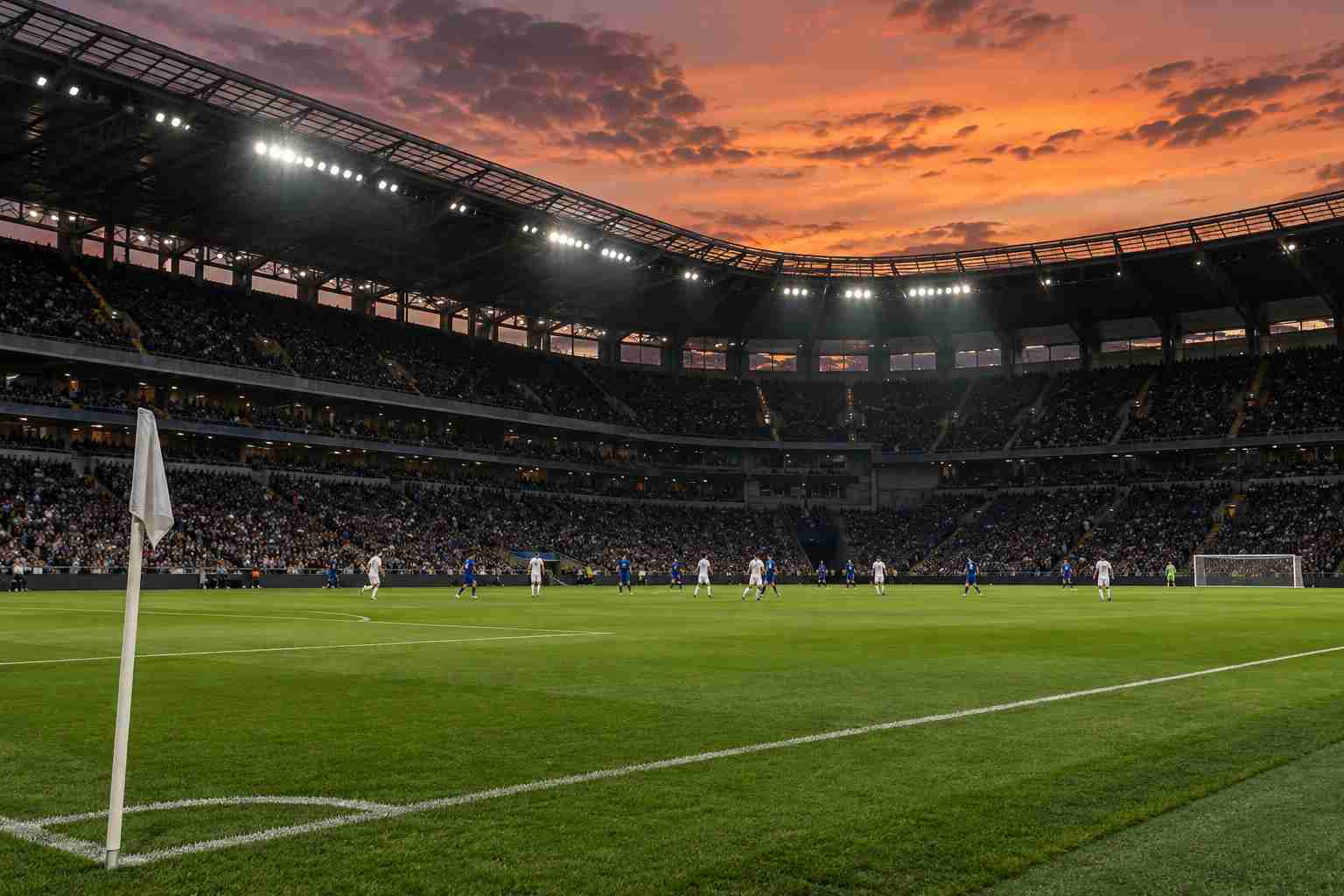
A clear guide to the 2026/27 UEFA Nations League: League A groups, match dates, standings, tiebreakers and the route to the finals.
Updated 2 October 2026. This is a guide to the competition format, not a live results page. For current scores and standings, use UEFA’s official fixtures and results.
Why are England playing Spain and Croatia again? Why are France, Italy and Belgium in the same group? These are not random friendlies. They are part of the 2026/27 UEFA Nations League, a European national-team competition that turns international windows into a league with a route to a trophy, promotion and relegation.
If you have just arrived from a match search, here is the quick answer: teams play others in their four-team group home and away. A win is worth three points, a draw one and a loss none. The strongest League A teams reach the quarter-finals, while league positions also affect movement between divisions. This season’s promotion and relegation rules are unusual because UEFA is changing the league structure for 2028/29.
What is the UEFA Nations League?
The Nations League is a competition for European national teams, organized in divisions called leagues. In League A, four groups of four contain many of the best-known sides. The group stage gives each team six matches: one at home and one away against each of its three opponents. Group points determine the table; they are not simply a count of wins. UEFA’s 2026/27 regulations confirm the home-and-away format and the three-one-zero points system.
Which major teams are in each League A group?
The draw creates several attention-grabbing matchups. This is the official League A group lineup:
- A1: France, Italy, Belgium, Türkiye.
- A2: Germany, Netherlands, Serbia, Greece.
- A3: Spain, Croatia, England, Czechia.
- A4: Portugal, Denmark, Norway, Wales.
That explains why searches for matchups such as Spain–Croatia, France–Belgium and Germany–Greece cluster around this competition. Those matches are only part of the story: each team must manage a six-match group campaign, not just one headline fixture.
When are the remaining 2026/27 matches?
As of 2 October 2026, the league phase is under way. Matchday 3 runs from 30 September to 3 October, followed by matchday 4 on 4–6 October. Matchday 5 is scheduled for 12–14 November and matchday 6 for 15–17 November 2026. The quarter-finals and play-offs are scheduled for 25–30 March 2027; the finals are set for 9–13 June 2027. Dates and individual kick-off times can change, so check the UEFA competition guide before planning to watch.
How do the standings work if teams finish level on points?
A common mistake is to assume the team with the best overall goal difference automatically finishes higher. Under Article 15 of UEFA’s rules, completed groups first compare results between the tied teams: points earned in their head-to-head matches, then goal difference and goals in those matches. Only if the tie remains do later criteria, including overall group results, come into play. A big win against another opponent therefore may not settle a head-to-head tie.
How do teams reach the finals—or move between leagues?
In League A, the top two in each group progress to the quarter-finals. The four quarter-final winners reach the finals in June 2027. Movement between leagues is more complicated than “last place goes down” this season. UEFA plans to move to three leagues of 18 teams from 2028/29, so 2026/27 includes special promotion, relegation and play-off paths. In League A, some third- and fourth-placed sides enter A/B play-offs, while the bottom two fourth-placed teams are relegated. League B group winners are promoted, and League C group winners also go up. For the full league-by-league scenarios, see UEFA’s format explanation.
There is also a connection to the road to UEFA EURO 2028: Nations League performance can provide a second-chance route into the qualifying play-offs for some teams. The exact route depends on the competition’s qualification rules, so the Nations League should not be confused with a direct EURO 2028 qualification tournament.
What should a new viewer watch for?
Start with your team’s group, then look at points and remaining home and away matches. A dramatic single result can shift the table, but the league is decided over all six group games. When teams are level, check their head-to-head results before overall goal difference. Finally, use official live fixtures and tables rather than an old article for current standings: this guide explains the rules, not a constantly changing scoreline.
For clubs inspired by the international window, there is a separate practical side to the game: kit design and ball selection. Our guides to 2026/27 soccer jersey ideas and soccer ball construction methods focus on those decisions. USSportWear is an independent sportswear business and is not affiliated with UEFA or the Nations League.
Quick questions
Is the Nations League the same as EURO 2028 qualifying?
No. It is a separate competition, although Nations League results can influence some teams’ routes to EURO 2028 qualifying play-offs.
Where can I see today’s Nations League scores?
Use UEFA’s fixtures and results for the latest official information.
