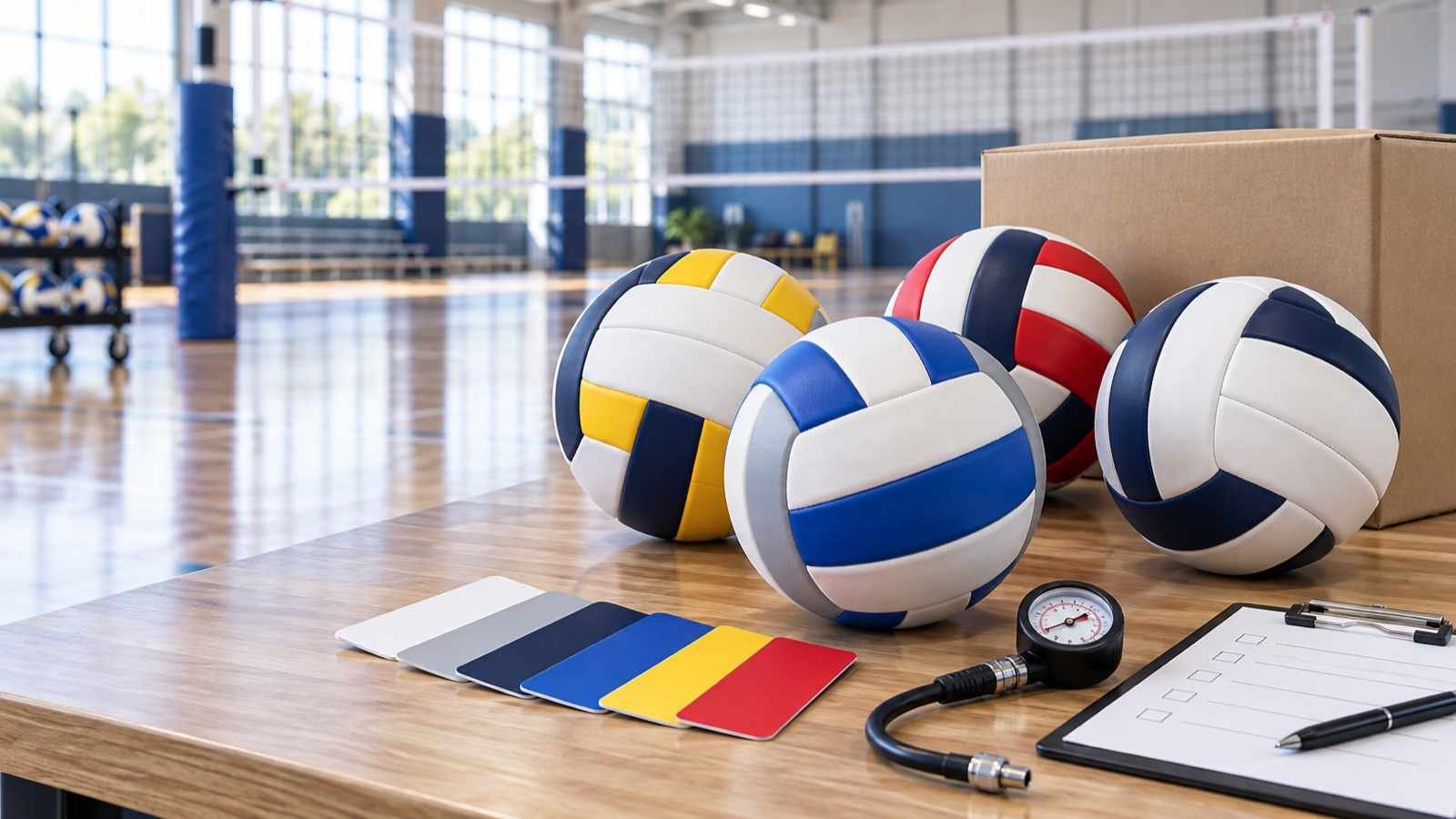
A practical guide to specifying custom volleyballs for schools, clubs, tournaments, sponsors and private-label programs.
Custom volleyballs can serve as training equipment, tournament assets, sponsor merchandise or private-label products. The correct specification depends on where the ball will be played, who will use it and how the branding must perform. A logo does not turn a generic ball into the right product; materials, construction, pressure, weight and testing matter first.
This guide is for schools, clubs, academies, tournament organizers and promotional buyers ordering in bulk. For a wider category plan, also read our custom sports balls buyer’s guide.
Start with the playing environment
Indoor volleyball, beach volleyball, youth training and promotional display are different applications. Indoor balls are designed around controlled court play, while beach balls need to perform in outdoor conditions and are evaluated under a different rule set. A promotional volleyball may emphasize artwork and presentation but should never be described as a match ball unless it has been specified and tested for that purpose.
Define the use in one sentence
- Indoor school training for players aged 14 to 18
- Club practice and local competition on indoor courts
- Outdoor beach tournament with sponsor branding
- Mini volleyballs for corporate gifts or event souvenirs
- Private-label range for a sports distributor
This simple definition keeps suppliers from quoting different products under the same name.
Know the official ball specification
The FIVB Official Volleyball Rules 2025–2028 state that a standard volleyball is spherical, with a flexible leather or synthetic-leather case and a rubber or similar bladder. The rules specify a circumference of 65–67 cm, a weight of 260–280 g and an internal pressure range for official volleyball play.
Use the official FIVB rules library as a technical reference. Your local federation, school association or tournament may add its own requirements, so confirm the applicable standard before ordering.
Do not confuse size with suitability
A ball can be the correct circumference and still be wrong for a program. Cover feel, panel construction, bladder, pressure retention and weight distribution affect how it plays. Ask for a complete specification instead of accepting “official size” as the only quality statement.
Compare indoor, beach and promotional volleyballs
Indoor volleyballs
Indoor balls are normally selected for consistent touch, controlled flight and suitability for a smooth court environment. Buyers should evaluate cover feel, panel seams and response during passing, setting and serving. A sample should be tested by coaches or experienced players on the actual court type.
Beach volleyballs
Beach volleyball involves outdoor exposure, sand and changing weather. Buyers should request the appropriate beach specification rather than assuming an indoor ball can be relabeled. Confirm material, moisture behavior, panel construction and the specific competition rules.
Training volleyballs
Schools and academies may prioritize repeatable feel, durability and easy inventory control. A training order can include color coding or visible size and program marks, but the branding must not create a slippery or uneven surface.
Promotional and mini volleyballs
These are useful for sponsor gifts, fundraising and displays. They offer more freedom in color and presentation but should be clearly described as promotional when not designed for regulation play. This protects the buyer from making a misleading product claim.
Choose the cover material carefully
Volleyball covers are commonly described as leather, synthetic leather or softer training materials. Those labels alone do not reveal thickness, texture, backing or durability. Request samples and documented construction details.
- Synthetic leather: widely used across training and game-oriented products, with many possible textures and performance levels.
- Leather: may be considered for premium indoor positioning, subject to the target standard and maintenance expectations.
- Soft-touch training covers: can suit beginners or high-repetition practice, but must be assessed for the intended age and program.
- Promotional surfaces: may prioritize print quality and should not automatically be marketed for competitive play.
When comparing quotes, require each supplier to state the exact cover and backing rather than using only terms such as “premium PU.”
Understand panel and bladder construction
Panel shape, bonding or stitching, lining and bladder construction influence roundness, air retention and flight. Different manufacturing methods can be appropriate for different product levels. What matters is that the supplier describes the proposed construction and that the approved sample represents production.
Questions for the specification sheet
- How many panels are used and how are they joined?
- What is the cover material and surface texture?
- What backing or lining supports the cover?
- Which bladder and valve are used?
- What are the target circumference, weight and pressure ranges?
- Is the product intended for indoor, beach, training or promotional use?
Design logos for a curved, paneled surface
Volleyballs with logos need artwork that remains readable across curved panels. Thin text, detailed crests and artwork placed too close to seams can reproduce poorly. Supply vector files and request a panel map or placement mockup before a physical sample is made.
Prepare a useful artwork pack
- AI, EPS or print-ready vector PDF files
- Approved color references
- Minimum clear space around the logo
- Exact number of print positions
- Rules for sponsor hierarchy and mark size
- Required model, size or warning text
View the mockup at realistic size. A logo that looks clear on a large monitor may become unreadable when printed on one panel.
Separate team, tournament and private-label needs
A club may need a crest and simple carton labels. A tournament may need sponsor versions, court allocation and event-specific delivery dates. A private-label buyer may also need model codes, barcodes, packaging files and repeat-order controls. List these as separate requirements so the quote can be compared accurately.
If multiple designs share one construction, identify the quantity per design. Do not assume a total order quantity automatically satisfies a supplier’s minimum for every color or logo variation.
What to include in a volleyball RFQ
A good request for quotation removes guesswork. It should contain enough detail for different suppliers to quote the same product.
- Indoor, beach, training or promotional application
- Target users and governing standard
- Quantity for each design and variation
- Cover, panel construction, bladder and valve preference
- Target circumference, weight and pressure
- Vector artwork, colors and print positions
- Sample and approval requirements
- Packaging, labels and carton marks
- Destination postal code and required delivery window
- Any test report or compliance documentation genuinely required
Review our custom manufacturing services process, then request a bulk quotation with this information.
Test a physical sample
For a new construction, artwork approval is not enough. Inflate the sample to the stated pressure and evaluate it in the intended environment. Record the test conditions so feedback is meaningful.
Sample checklist
- Measure circumference and weight
- Inspect roundness and panel alignment
- Check grip during passing, setting and serving
- Observe flight and bounce consistency
- Monitor pressure retention over an agreed period
- Inspect logo position, opacity and color
- Confirm labels, packaging and carton information
Keep the approved sample and signed specification as the reference for production and future reorders.
Create a proportionate quality-control plan
Quality control should address function as well as appearance. Agree on measurement tolerances, inspection timing and the action required if goods do not match the approved sample. For higher-value or first-time orders, consider an independent pre-shipment inspection appropriate to the risk.
Do not publish claims such as “FIVB approved,” “match certified” or “official tournament ball” unless the exact product has valid evidence supporting that wording. Meeting a dimension from a rulebook is not the same as holding an approval.
Compare quotations on a like-for-like basis
Normalize every proposal by cover material, construction, bladder, artwork positions, sample cost, packaging, production time, freight basis and payment terms. A lower unit price can reflect a different ball, not better value.
Also ask how replacement or corrective action is handled if branding, measurements or packaging fall outside the agreed specification. Written acceptance criteria are more useful than vague quality promises.
Common mistakes in bulk volleyball orders
- Using an indoor specification for a beach event
- Approving only the logo and not the complete ball
- Accepting “official size” without weight or pressure details
- Placing fine artwork across seams
- Skipping testing by the actual users
- Mixing different designs without confirming minimums
- Using unsupported approval or certification language
Why this is a realistic SEO opportunity
SEMrush US currently reports “custom volleyballs” at 260 monthly searches with KD 1 and mixed informational/commercial intent. That is unusually accessible compared with many broad sporting-goods terms. The strongest approach is one commercial volleyball landing page supported by this buyer guide, not many thin posts targeting tiny wording changes.
Related pages should cover distinct needs such as custom indoor volleyballs, custom beach volleyballs or promotional volleyballs only when the catalog genuinely offers different specifications. This keeps the site architecture clear and avoids keyword cannibalization.
Request a custom volleyball quote
Send the application, quantity, target specification, destination and vector artwork. USSportWear can review the brief and prepare a quote-based bulk proposal for your club, school, tournament, corporate campaign or private-label program.
Request a quote for custom volleyballs and include your intended playing environment in the message.
