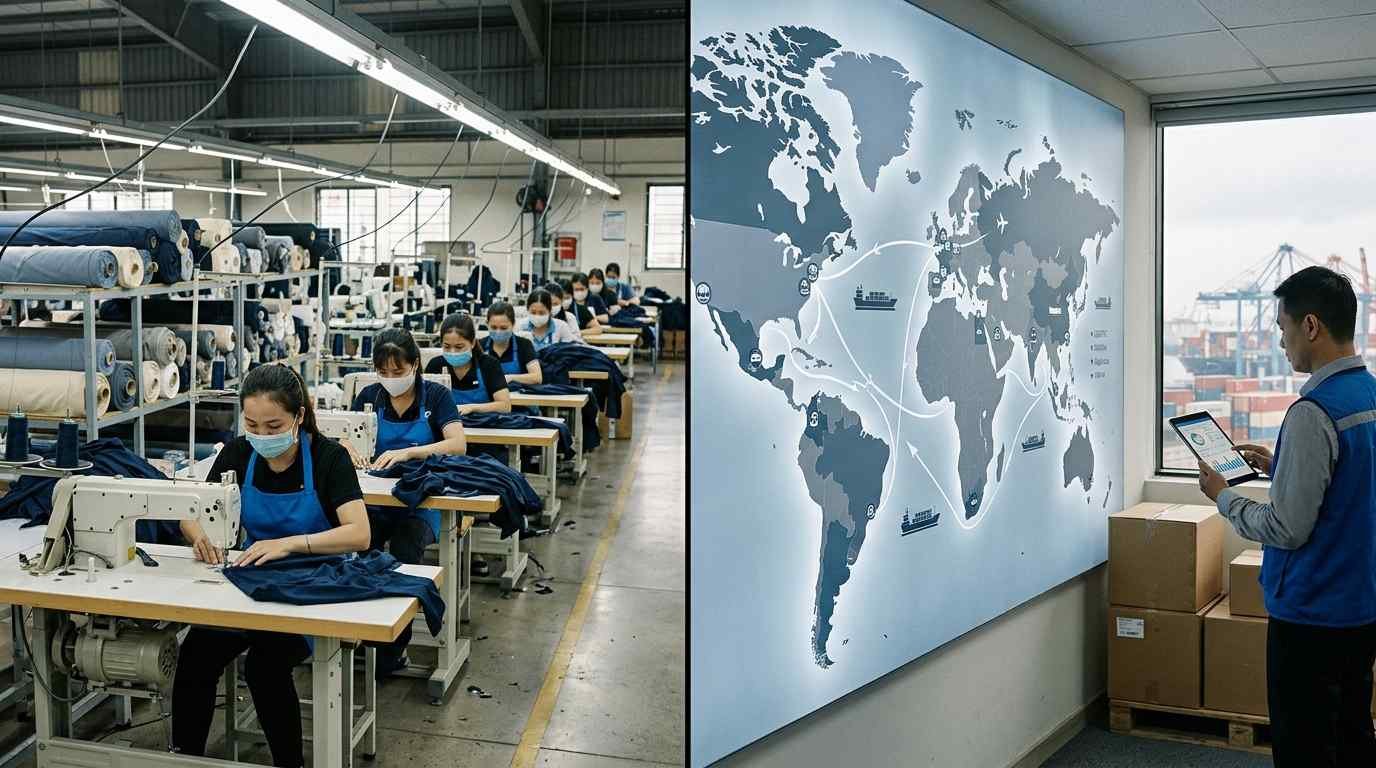
A practical comparison framework for buyers weighing a US-based sportswear manufacturer against sourcing directly from an overseas factory — lead time, communication, MOQ and cost.
Buyers comparing a US-based sportswear manufacturer against sourcing directly from a factory overseas are often comparing the wrong things — unit price alone, without accounting for lead time, communication overhead, minimum order quantities and the real cost of a miscommunicated specification. This guide sets out a practical comparison framework rather than arguing one route is universally better.
Unit price is not the full cost comparison
A lower quoted unit price from an overseas factory can look decisive until the rest of the order's real costs are added: freight, import duties, the cost of a sample round-trip if the first attempt misses the specification, and the time value of a longer lead time if your event or season has a fixed date. Build a like-for-like comparison that includes all of these, not just the per-unit factory quote.
Lead time: production time vs. total time to delivery
Production time (how long the factory takes to make the order once specifications are confirmed) is only part of total lead time. Add sample development and approval rounds, shipping time, and customs clearance for an overseas order — the total can run considerably longer than the production time alone suggests. A domestic or nearer manufacturer generally has a shorter shipping and customs component, which matters most when you're working against a fixed season start or event date.
Communication and specification accuracy
Time zone overlap, language and cultural differences in how a specification is interpreted, and the number of communication rounds needed to confirm a detail all affect how accurately the finished product matches what you actually asked for. This isn't a claim that overseas communication is inherently worse — it's a real variable that adds friction and revision rounds regardless of factory quality, and it's worth weighing directly rather than assuming it away.
Minimum order quantities
MOQ requirements vary by manufacturer and product far more than by geography alone — some overseas factories require large minimums to make custom production worthwhile, while some domestic manufacturers offer lower minimums specifically to compete on flexibility rather than unit price. Confirm the actual MOQ for your specific product and manufacturer rather than assuming a pattern based on where the factory is located.
Where each route tends to make more sense
- Overseas sourcing can make sense for very large, standardised orders where per-unit cost is the dominant factor and lead time has significant buffer built in.
- A US-based manufacturer tends to make more sense for smaller or mid-volume orders, tighter timelines, complex or evolving specifications that benefit from faster communication rounds, and buyers who want to inspect samples and production in person or through a shorter feedback loop.
Neither is automatically the right answer — the right choice depends on your order size, timeline and how much specification complexity your product actually has.
Questions worth asking either type of supplier
- What's the full lead time from confirmed specification to delivery at my door — not just production time?
- How many sample rounds are typically needed to reach final approval, and what does each round cost in time?
- What's the actual MOQ for my specific product, not a general minimum quoted for the factory as a whole?
- Who is my direct point of contact, and what's the realistic response time for a specification question mid-production?
A practical decision framework
Weigh your order against three questions: How fixed is your delivery deadline? How complex or likely to need revision is your specification? How much does per-unit cost matter relative to total landed cost and lead-time risk? An order with a hard deadline and a complex, evolving specification generally favours faster communication and shorter shipping — an order with significant time buffer and a simple, locked specification has more room to prioritise unit cost.
Request a quote and compare directly
The most reliable comparison is a real quotation for your actual specification, not a general assumption about overseas vs. domestic manufacturing. USSportWear manufactures custom sportswear domestically for clubs, schools, academies and distributors — request a quote with your specification, quantity and timeline, and compare it directly against any other quotation you're evaluating.
