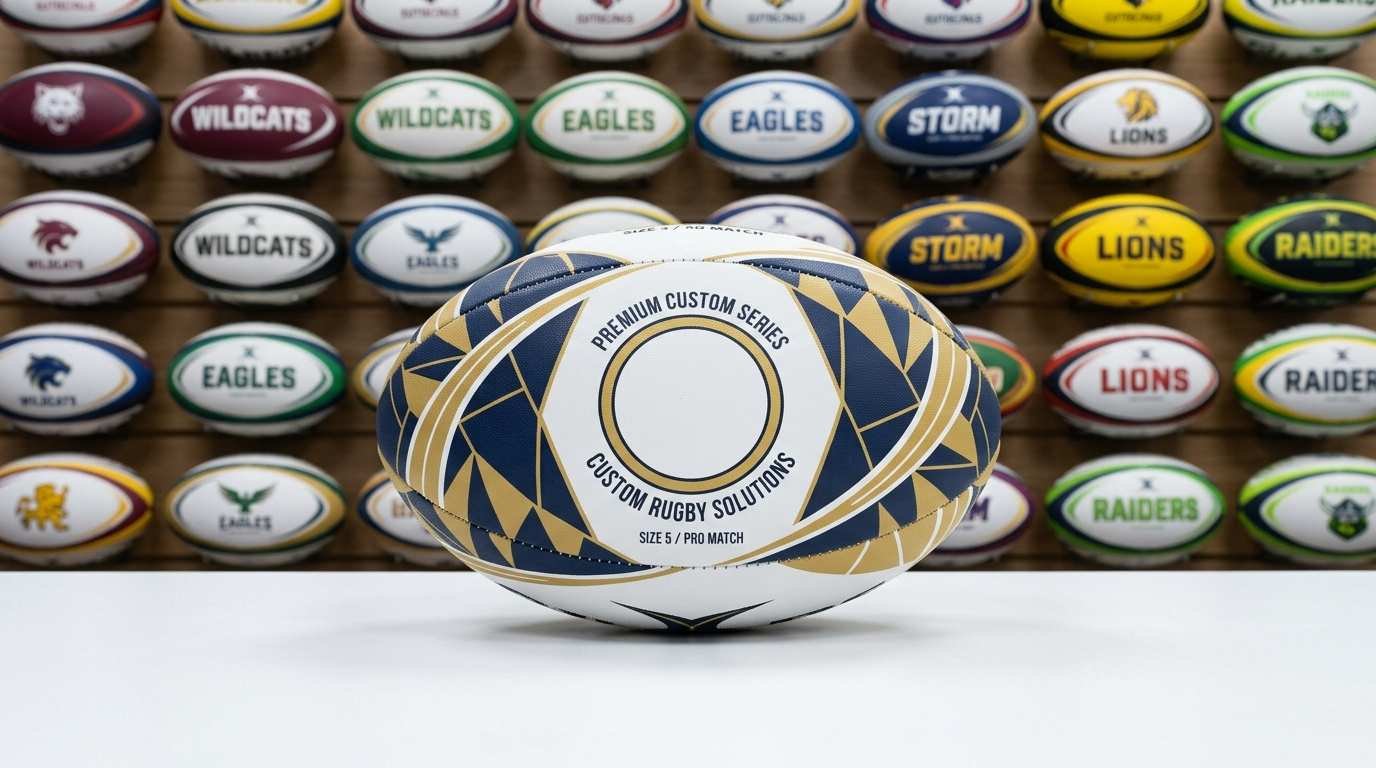
How clubs, schools, tournaments and brands can specify custom rugby balls for training, matches, sponsors and promotions.
Custom rugby balls can support club identity, school training, tournament sponsorship and private-label sales. But rugby buyers should specify the playing purpose before choosing artwork. A match-oriented ball, a high-volume training ball and a promotional mini ball are not interchangeable.
This guide gives bulk buyers a practical brief for comparing suppliers. It complements our custom sports balls buyer’s guide and focuses on the decisions that matter for rugby.
Define the rugby code and use
Start by stating whether the program plays rugby union, rugby league, sevens, touch, tag or a youth variation. Governing bodies and age-grade programs may apply different requirements. Then identify whether the ball is for matches, daily training, kicking practice, presentation or promotion.
Write a clear use statement
- Adult club training on natural and artificial grass
- School rugby for a defined age group
- Tournament match supply with sponsor marks
- Mini branded rugby balls for corporate gifts
- Private-label training range for a distributor
This prevents suppliers from making different assumptions when they quote.
Confirm the official dimensions
World Rugby Law 2 describes the full-size ball as oval and made from four panels. It specifies a length of 280–300 mm, an end-to-end circumference of 740–770 mm, a width circumference of 580–620 mm and a weight of 410–460 g. The law also notes that smaller balls may be used for young players.
Refer to the 2026 World Rugby Laws of the Game and verify any local union or competition variation before production. Meeting dimensions alone does not prove that a particular product is approved for a competition.
Plan the size mix by player group
Many programs use size 5 for adult play, with smaller sizes for younger players. Do not order one size for every squad without checking the relevant union rules. A multi-age club should show the quantity for each size as a separate line in the purchase brief.
Visible size markings are useful for equipment managers. If colors are also used to separate squads or age groups, document that system so reorders remain consistent.
Select grip for actual conditions
Rugby involves handling in rain, mud and changing temperatures. The surface texture and treatment can affect control, especially during passing and kicking. Ask suppliers to describe the grip pattern and intended conditions instead of relying on words such as “pro grip.”
Evaluate a sample in context
- Test with dry and damp hands
- Pass at short and long distances
- Kick from hand and from a tee where relevant
- Inspect the surface after repeated training use
- Check whether branding creates a different feel
A visually attractive sample is not enough if the grip becomes inconsistent during play.
Understand cover, lining and bladder
Rugby balls may use leather or suitable synthetic materials. Modern training and match-oriented products frequently use synthetic covers, but performance varies by texture, backing and construction. Ask for the precise material specification.
Lining supports shape and response, while the bladder and valve affect air retention. Panel cutting and assembly influence symmetry. A serious quotation should identify these components and the intended product level.
Specification questions
- What is the cover material and grip texture?
- Is the surface treated for water resistance?
- How are the four panels constructed and joined?
- What lining, bladder and valve are used?
- What size, weight and pressure tolerances apply?
- Is the model intended for training, matches or promotion?
Design branding around four panels
Branded rugby balls need artwork that works on a pointed, curved form. Fine text near panel seams can distort. Large sponsor marks may compete with required size, pressure or model information. Use a panel map and define each print position.
Supply vector artwork, approved colors and clear-space rules. Ask for a scale mockup and then inspect a physical sample. Colors displayed on screen are not a reliable production standard.
Common branding programs
- Club crest and team name
- School identity and season year
- Tournament logo with sponsor hierarchy
- Private-label brand, model and size
- Commemorative or presentation design
Do not use protected event or league marks without permission. The buyer should confirm it has rights to every supplied logo.
Separate playable and promotional products
A promotional mini ball can provide a larger relative branding area and lower shipping weight, but it should not be presented as regulation match equipment. Likewise, a display ball may prioritize finish rather than wet-weather grip or repeated impact.
If one campaign needs playable balls and giveaways, list them as separate products. This improves quotation accuracy, product descriptions and quality checks.
Build a complete rugby ball RFQ
- Rugby code, playing level and intended use
- Size and quantity by design
- Cover, grip, lining and bladder requirements
- Target dimensions, weight and pressure
- Artwork files, colors and panel locations
- Sample approval and testing plan
- Packaging, labels and carton marks
- Destination postal code and delivery window
- Required documentation supported by a real need
Review our custom manufacturing services, then request a bulk quotation using this checklist.
Test before authorizing production
Inflate the sample to the agreed pressure and record the conditions. Measure length, circumferences and weight. Check symmetry, seam quality, valve position, grip, passing response, kicking behavior and air retention. Inspect artwork after the performance test, not only when the ball is new.
Keep the approved sample and signed specification. For repeat orders, compare production against the same reference rather than approving from memory.
Plan production quality control
Agree on tolerances and inspection timing before the order begins. Checks should include materials, construction, measurements, print registration, color, packaging and carton quantities. A proportionate pre-shipment inspection can reduce risk for first orders or new specifications.
Never publish claims such as “World Rugby approved” or “official match ball” without evidence for the exact model. A less experienced seller may confuse rule dimensions with formal approval; they are not the same.
Compare quotations accurately
Normalize cover, grip, construction, bladder, artwork positions, sample costs, packaging, production time, freight basis and payment terms. The cheapest line may describe a different product. Require suppliers to list exclusions and assumptions.
Also confirm how variation quantities affect setup and minimums. Ten logos across one total quantity can be very different from one design at the same volume.
Common ordering mistakes
- Failing to identify union, league or age-grade rules
- Using a single size for every squad
- Approving artwork without testing grip and flight
- Placing small text across seams
- Combining match and promotional requirements
- Comparing quotations with different construction
- Making unsupported approval claims
Why rugby is a strong SEO target
SEMrush US currently reports “custom rugby balls” at 140 monthly searches with KD 2 and commercial intent; the singular version shows 170 searches with KD 3. This is a realistic entry point for a low-authority B2B site. One commercial landing page should target the core term, supported by this guide and genuinely distinct pages only where the product changes.
The opportunity is stronger than producing many thin articles for spelling or plural variations. Build depth around sizes, training, tournaments and promotional use while keeping one clear primary URL.
Request a custom rugby ball quote
Send your rugby code, size mix, quantities, material and grip preference, destination and vector artwork. USSportWear can review the brief and prepare a quote-based proposal for clubs, schools, tournaments, sponsors and private-label programs.
Request a quote for custom rugby balls and include the intended playing conditions.
